


Fair Trade is a good tool for Sustainable Development. The 10 principles for Fair Trade reflects the ecological-social-economic aspects of Sustainable Development. Crafts can meet high ecological criteria e.g. materials and production, high social standards e.g. gender equality, high economic standards e.g. value added.
Madagascar has one of the world’s highest percentage of extreme poverty (80,0 %). At the same time, it has a rich and unique flora and fauna to preserve. Madagascar is one of the world’s “biodiversity hotspots”. In this context, Fair Trade crafts stands out as an exceptionally good choice.
-
Sustainable development - definition
"Sustainable development is a development that meets the needs of today without compromising the ability of future generations to meet their needs."
Bruntland Report, 1987Sustainable development has been defined in many ways, but the most common citation definition is from the "Brundtland Report", a report written by the World Commission on Environment and Development on behalf of the United Nations in 1987. The report's title: ”Report of the World Commission on Environment and Development: Our Common Future”
-
Sustainable development - models
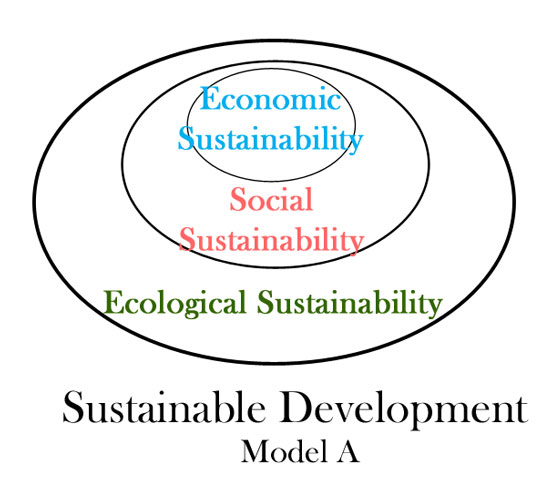
Model A
The three dimensions (ecological, social, economic) of Sustainable Development can be visualized as three circles where ecological sustainability constitutes the outer limit of what is possible. The three circles can alternatively be placed on top of each other in a hierarchy, where ecological sustainability forms the foundation for the social and economic.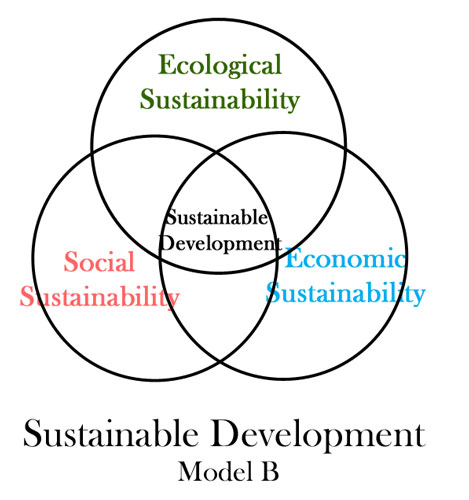
Model B
The three dimensions (ecological, social, economic) of Sustainable Development can be visualized as three circles that partially overlap. This model conveys an image of sustainable development where all three dimensions are not only needed, but also given equal weight and value. -
Agenda 2030 for the Sustainable Development Goals
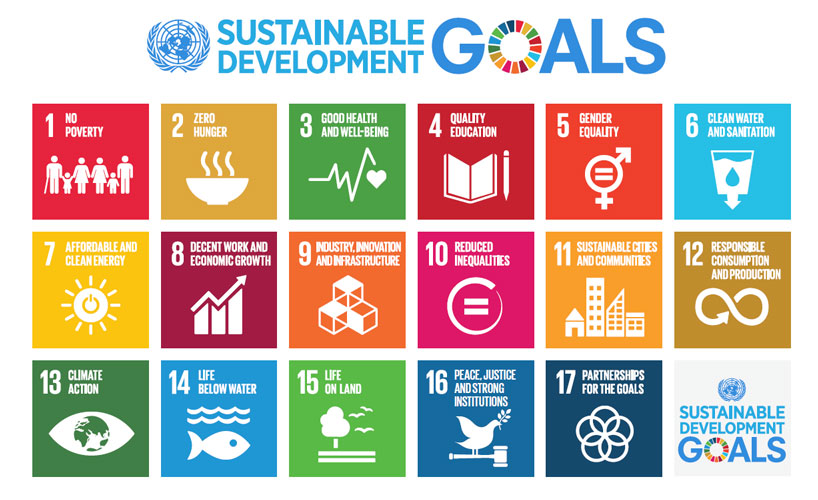
Sustainability is the basis of today's leading global framework for international cooperation: Agenda 2030 for Sustainable Development Goals (SDGs).
It was at the UN summit on 25-27 September 2015 that world leaders set the 17 global goals for Sustainable Development for the period up to 2030.
The 17 Goals for Sustainable Development are:
1.No Poverty
2.Zero Hunger
3. Good Health and Well-being
4. Quality Education
5. Gender Equality
6. Clean Water and Sanitation
7. Affordable and Clean Energy
8. Decent Work and Economic Growth
9. Industry, Innovation and Infrastructure
10. Reduced Inequality
11. Sustainable Cities and Communities
12. Responsible Consumption and Production
13. Climate Action
14. Life Below Water
15. Life on Land
16. Peace and Justice Strong Institutions
17. Partnerships to achieve the Goal“LEAVE NO ONE BEHIND.”
The defining principle of the Global Goals and Agenda 2030 is a joint pledge by every country to work together to ensure the rights and well-being of all on a healthy, prosperous planet.SUSTAINABLE DEVELOPMENT REPORT 2025
Subtitle: "Financing Sustainable Development to 2030 and Mid-Century"
Two key messages in Sustainable Development Report 2025:
A) On average globally, the SDGs are far off-track. At the global level, none of the 17 goals are currently on course to be achieved by 2030.
Ref: Page 11 « Based on the rate of progress since they were adopted by the international community in 2015, none of the 17 SDGs will be achieved by 2030. At the global level, SDG 2 (Zero Hunger), SDG 11 (Sustainable Cities and Communities), SDG 14 (Life Below Water), SDG 15 (Life on Land) and SDG 16 (Peace, Justice and Strong Institutions) are particularly off track, facing major challenges (indicated in red on the dashboards) and showing no or very limited progress since 2015.”
Note: Each of the goals consists of 8-12 targets. In total, there are 169 SDG targets for the 17 17 sustainability goals. Of these targets, 16,7 % are however on track to be achieved globally.
B) The need for fair financing
For many developing countries, a lack of fiscal space is the major obstacle to SDG progress.
Roughly half the world's population lives in countries that cannot invest adequately in sustainable development due to debt burdens and a lack of access to affordable, long-term capital. Global public goods are vastly under-financed.
The report acknowledge that high-income countries have a special responsibility, both as a matter of distributive justice – that the rich not leave the poor behind – and as a matter of reparative justice – that those countries that contributed most to greenhouse gas emissions and other environmental harms in the past must do the most to curb their emissions in the future and to compensate the other countries for the damages their past actions have caused.
The report also state that UN member states must increase their financing of the global commons, including the biodiversity of the world’s tropical rainforests; the marine life of the oceans; and the protection of the atmosphere, freshwater, soils, coastlines, wetlands, and other ecosystems from transboundary pollution and global-scale degradation. The high-income countries bear the responsibility for filling the funds they have designated for these purposes, including the Adaptation Fund, the Loss and
Damage Fund, the Green Climate Fund, and others. -
Fair Trade is a good tool for sustainable development.
For example, Fair Trade principle number 1 is “Creating opportunities for economically marginalized producers”. It is perfectly in line with SDG number 1 No poverty. Fair Trade principle number 10”Respect for the environment” reflects SDG 12 Responsible consumption and production, 13 Climate action and 15 Life on land. Another example is Fair Trade principle number 6, which is reflected by SDG 5 Gender equality. Finally, Fair Trade practice in its daily work and at grass root level SDG 17: Partnership for the goals.
The 10 principles of Fair Trade lead the work of Fair Trade organizations such as La Maison Afrique FAIR TRADE. They are principles that have been worked out for many years within the international Fair Trade movement.
-
The 10 principles for Fair Trade are
1. Creating Opportunities for Economically Disadvantaged Producers
2. Transparency and Accountability
3. Fair Trading Practices
4. Payment of a Fair Price
5. Ensuring no Child Labour and Forced Labour
6. Commitment to non-Discrimination, Gender Equity and Freedom of Association
7. Ensuring good Working Conditions
8. Providing Capacity Building
9. Promoting Fair Trade
10. Respect for the Environment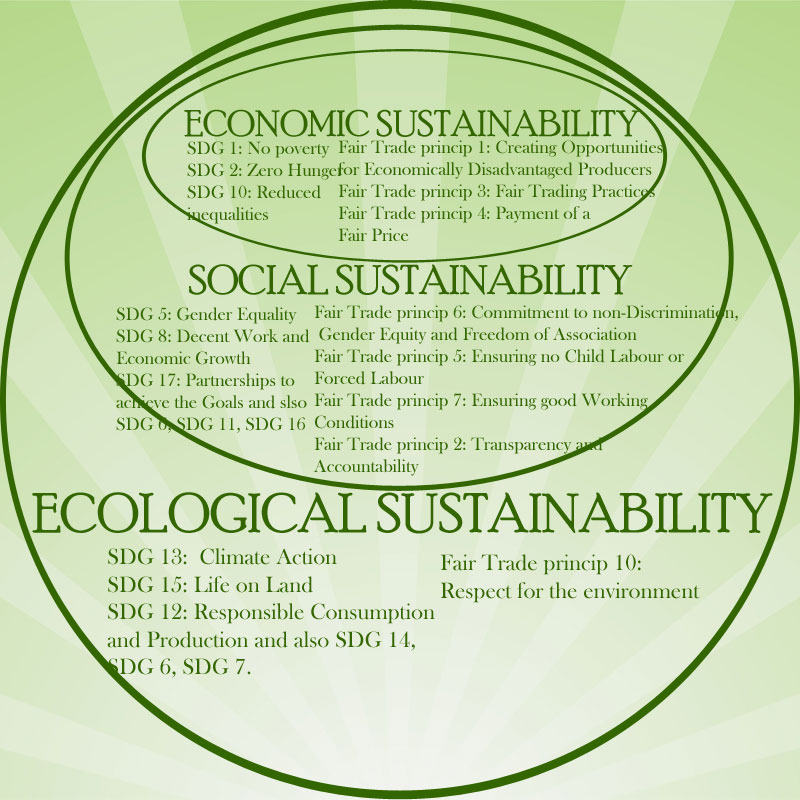 The image above shows again the model (A) for Sustainable Development where the dimensions (ecological, social, economic) of Sustainable Development are described in the form of three circles where ecological sustainability constitutes the outer limit of what is possible.
The model contains suggestions for how Sustainable Development Goals (SDGs) and, in parallel, Fair Trade principles can be placed. NB: The placement of goals/principles in the model is only a suggestion. -
Global Sustainable Development - demands engagement for global fairness
The World Bank writes in its "Poverty Overview" that the number of people globally in extreme poverty has decreased from about 2.3 billion in 1990 to 831 million in 2025. However, the global poverty reduction is due to broad and robust economic growth in Asia. Extreme poverty has increasingly become concentrated in Sub-Saharan Africa. Climate change, increased interest costs and conflicts have burdened these already poor countries the worst - which means that the number of people living in extreme poverty is still unacceptably high and there is reason to believe that the Sustainable Development Goal (SDG) of reducing the proportion of people living in extreme poverty to below 3% by 2030 will not be achieved.
Climate Justice
The climate crisis is unfair: The poorest countries have contributed the least to the ongoing climate change - but are the ones who are suffering the most. Climate change (cyclones, droughts, floods, etc.) prevents the economic and social development of poor countries.
Without climate justice, global development will not be sustainable.Climate debt
Definition: “Climate debt is a concept rooted in climate ethics, emphasizing equity and historical responsibility. It highlights the accountability of countries that have contributed the most to climate change and pollution, placing them at the forefront of addressing global warming and its adverse effects.
This debt is owed to developing nations, who bear the brunt of climate impacts despite contributing the least to the problem. Developed nations, having reaped economic and developmental benefits at the cost of environmental degradation, must compensate these nations through financial support for development, adaptation, and migration. Beyond this, they hold a humanitarian responsibility to restore the planet and work towards sustainable development for all.”
History of Climate Debt:
Since the Industrial Revolution, developed nations have disproportionately emitted greenhouse gases (GHGs) into the shared atmosphere, a resource that transcends borders and belongs to all. These emissions have led to catastrophic climate changes, forcing nations, ecosystems, and species worldwide to endure its impacts and adapt accordingly.
Current situation:
“Developing nations, despite contributing the least to this problem, are among the most vulnerable. This inequity is further exacerbated by economic constraints and the dual challenge they face: combating climate change while pursuing essential development goals” (such as the 17 Sustainable Development Goals defined in agenda2030.)Climate debt represents the obligation industrialized nations bear for their disproportionate historical greenhouse gas emissions.
How large are the differences in cumulated climate emissions between, for example, industrialized nations like USA, France and Sweden compared to Madagascar? – That is shown in the bar chart below.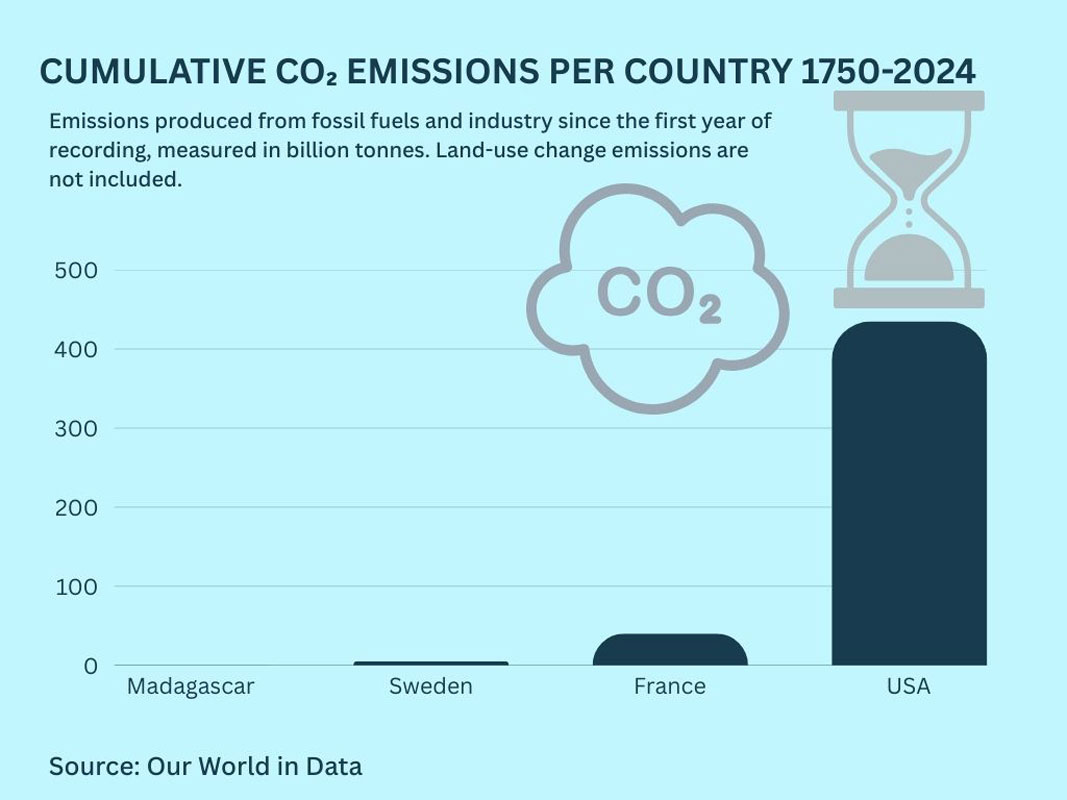
Cumulative CO2 emissions per country 1750-2024. Emissions produced from fossil fuels and industry since the first year of recording, measured in tonnes. Land-use change emissions are not included.
Madagascar's total cumulated CO2 emissions for the years 1750-2024: 0,11 billion tons. This can be compared to Sweden's 5.13 billion tons (45 times larger), France 40,05 billion tons (355 times larger) or USA's cumulated carbon dioxide emissions; 434.87 billion tons (which is 3860 times larger).
Source: Our World in Data
Note: To make a fair comparison of the countries, population needs to be taken into account. The four countries population 2023: Madagascar 31.2 M, Sweden 10.6 M, France 66.4 M, USA 343.5 M. Source: Our World in DataIndustrialized countries continue to overconsume planetary resources.
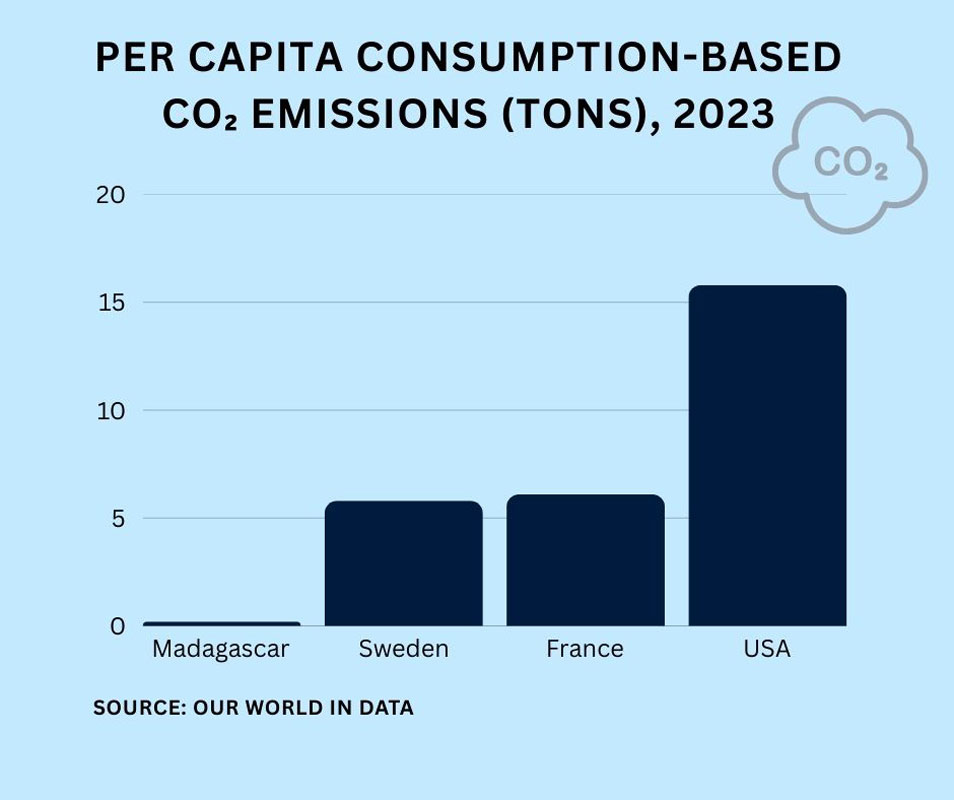
Per capita consumption-based CO₂ emissions, 2023. Consumption-based emissions are national emissions that have been adjusted for trade. It's production-based emissions minus emissions embedded in exports, plus emissions embedded in imports.
Madagascar's consumption-based carbon dioxide emissions per capita in 2023 were 0.2 tons. This can be compared to Sweden's; 5.8 tons (=29 times greater), France’s; 6.1 tons (=30 times greater) or the USA's consumption-based carbon dioxide emissions; 15.8 tons (=79 times greater). Source: Our World in DataComparing ecological footprints
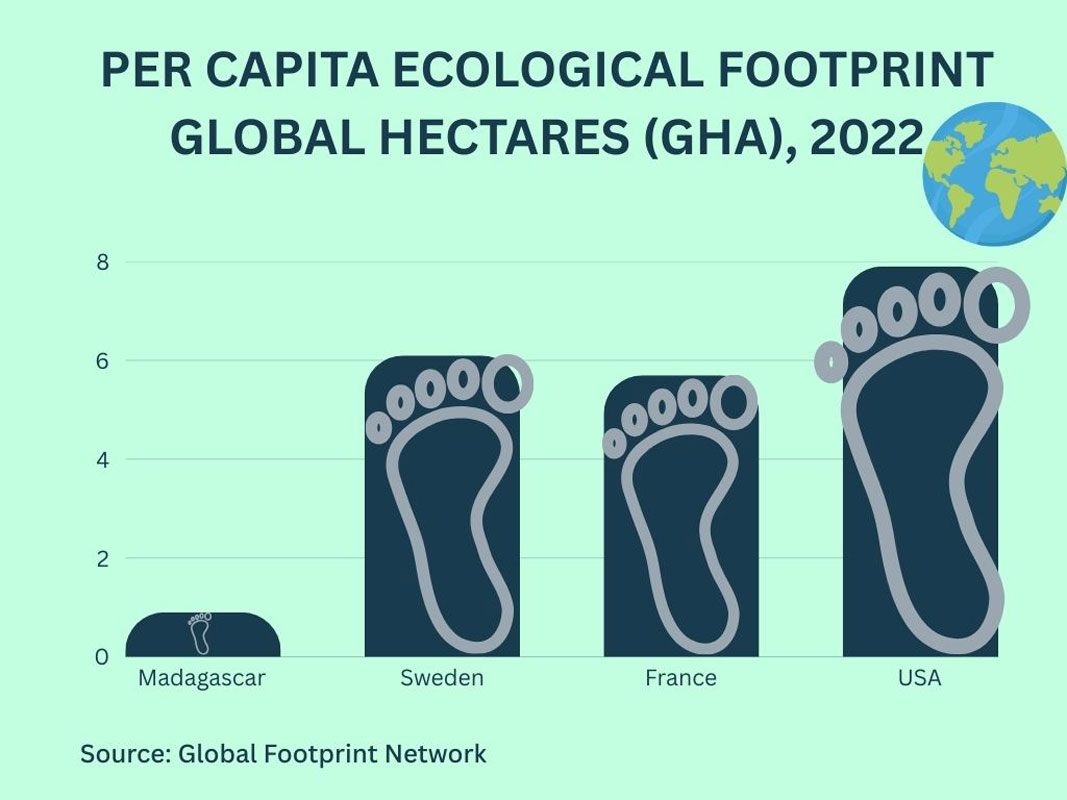
Ecological footprint is usually measured in global hectares (gha) per person. The measure shows how much of the Earth's natural resources a person (or country) consumes in relation to the Earth's ability to regenerate those resources. It includes everything from food and energy production to waste management and land use.
The per capita ecological footprint 2022 were for Madagascar: 0.9 Gha, Sweden 6.1 Gha, France 5.7 Gha, USA 7.9 Gha. Source: Global Footprint Network
Madagascar is one of the countries in the world that, according to the World Bank's Poverty data 2025, has the largest proportion (80,0%) of its population in extreme poverty - and which is severely affected by the escalating climate crisis and extreme weather events; cyclones, floods, prolonged droughts. -
Madagascar is consistently ranked as one of the world's most vulnerable nations to natural disasters
Madagascar is facing severe impacts from cyclones, floods, and prolonged droughts, which devastate communities, agriculture, and infrastructure, leading to widespread food insecurity.
Its location in the Indian Ocean makes it prone to powerful cyclones, while droughts frequently hit the south, creating a dual crisis for the largely impoverished population reliant on climate-sensitive livelihoods. In 2024, UN Resident Coordinator for Madagascar writes in the UN News: “Madagascar is the fourth most vulnerable country in the world to climate change. It is recurrently hit by droughts and cyclones that are increasing in frequency, duration and intensity due to climate change.”Cyclones:
Madagascar is considered the most cyclone-affected area in Africa.
Cyclones that have affected Madagascar the last few years include:
- 10th February 2026, cyclone Gezani swept across the east coast of Madagascar with wind gusts of up to 250 km/h (69.44 m/s). Cyclone Gezani, which was categorized as an "Intense Tropical Cyclone", passed near the country's largest port city of Toamasina (Tamatave), which is estimated to have been destroyed to 80-90%.
A total of 25 districts in five of the country's regions have been affected by Cyclone Gezani.
Madagascar's National Office for Risk and Disaster Management (BNGRC) reported after six days (February 16 at 08:30) that 59 people have died, while more than 423 000 people have been declared disaster victims. More than 75 000 houses have been partially or completely destroyed.National State of Disaster: On 11th of February 2026, Madagascar declared a national state of disaster in response to the scale of the devastation caused by the successive tropical cyclones Gezani and Fytia.
- 31st of January 2026, cyclone Fytia made landfall on the northwestern coast of Madagascar. The cyclone was classified as an “Intense Tropical Cyclone” with average wind speeds of 185 km/h (54.1 m/s) and gusts of up to 210 km/h. Combined with heavy rains, it caused flooding with extensive damage to infrastructure, housing, agriculture, etc., as well as deaths as the cyclone continued across Madagascar. Madagascar’s Bureau National de la Gestion des Risques et Catastrophes (BNGRC) makes a preliminary estimate of 59 deaths and more than 84,950 affected, including 33,652 displaced people living in temporary shelters in eight regions of the country.
- In Feb/March 2025, tropical cyclone Honde displaced 21 600.
- In March 2025, cyclone Jude hit Madagascar twice displacing over 46 000.
- In April 2024, Tropical Cyclone Gamane struck northeast Madagascar, leaving 220,000 people in urgent need of humanitarian assistance, including 22,000 internally displaced persons.
- Early 2023, cyclone Cheneso impacted 90 000 people and cyclone Freddy 187,400. The two cyclones displaced 88,000 people.
Early 2022, Madagascar was hit by two tropical storms and two cyclones:
- January 22nd tropical storm Ana,
- February 5th cyclone Batsirai,
- February 15th tropical storm Dumako
- February 21st cyclone Emnati.
"Even though it is a cyclonic season in the Indian Ocean, it is rare to see four storms hit the same country within four weeks," said Clare Nullis of the World Meteorological Organization (WMO) in the UN article, which also reminds of perennial drought for some time back causes famine in the southern part of the country.
Prolonged drought in southern Madagascar:
In November 2025, UN Organization for Coordination of Human Relief writes: “Madagascar is facing a deepening humanitarian crisis, mainly in the regions of Grand Sud and Grand Sud-Est, where 22 districts have been hit by a series of droughts, cyclones and other shocks this year and last. The lingering impact of the 2023-2024 El Niño drought and the 2024-2025 cyclone season – combined with a malaria outbreak and strained health systems – has left many communities with little ability to recover. As a result, Madagascar’s hunger crisis is intensifying, with the number of people facing emergency food insecurity – or Integrated Food Security Phase Classification (IPC) Phase 4 – in the Grand Sud region expected to quadruple to 110,000 by January 2026. Seven of 11 districts are already at crisis levels of hunger, IPC Phase 3. Cases of severe acute malnutrition in the Grand Sud region have surged in the past year, affecting nearly 160,000 children.”
The History behind the devastating droughts and famine in southern Madagascar:
On July 30, 2025, Amnesty International published a report recounting how, during the French colonial era in Madagascar, authorities deliberately unleashed harmful, genetically manipulated cochineal parasites across some 40,000 hectares (98,850 acres) of a drought-resilient vegetation in the Androy region in Madagascar’s deep South. Between 1924 and 1929, the parasites destroyed roughly 100km (62 miles) of vegetation cover each year.
This was not a minor ecological loss. The vegetation had sustained the Antandroy people for generations, providing food and helping to preserve groundwater through chronic droughts. Its destruction erased a vital natural defence system against those droughts. More than a century later, the destruction has left the Antandroy people exposed to recurring mass hunger, displacement, and death whenever drought strikes.
Furthermore, Madagascar’s droughts are being intensified by human-induced climate change, driven largely by high-income historically high emitting countries, such as France – the very colonial power that left the Antandroy people vulnerable.
Conclusion: True climate justice demands a reckoning with colonialism.-------
Climate crisis impacting on social-economical situation.
Madagascar has also repeatedly been hit by political crises (1972, 1991, 2002, 2009 and 2025). The combination of climate crisis and political crises has had a major impact on the economy as a whole and perhaps worst for the already poorest and most marginalized in society. Poor infrastructure, e.g. roads, water and electricity supply, is a result of political instability, natural disasters, widespread poverty. At the same time, Madagascar's poor infrastructure is a major obstacle to inclusive economic growth. More about that in the World bank group report 2021 mentioned above and e.g: In the Africa Competitiveness Report 2017, Madagascar has the bottom rank (ranked 138 out of 138 countries included) regarding road quality. In the World Bank report "Doing Business Madagascar 2020", Madagascar is ranked close to the bottom (186 out of 190 counted countries) regarding access to electricity. The country is ranked 161 when the assessment includes all ten indicators of the report on how difficult or easy it is to start and run a company there. -
At the same time, Madagascar has one of the richest and most unique flora and fauna in the world to preserve
Madagascar is, together with the smaller surrounding islands, one of the world’s “biodiversity hotspots”. Here below some figures to describe an immeasurable great value.
-
EndemismMadagascar and the surrounding islands has an extremely high floral and faunal endemism.
-
PlantsThe threshold of endemism for a region to qualify as biodiversity hotspot is 1500 endemic plants; the Madagascar flora alone comprises about 10 000 endemic species. For palm trees (Arecaceae), Madagascar is considered as one of the world’s richest places. The wealth is mainly characterised by endemism close to 100 %.
-
Regarding fauna, the level of species endemism is exceptional.
-
Mammals
Of the approx. 211 indigenous species of terrestrial mammals, 95% are endemic. Lemurs, which are endemic to Madagascar, are considered the world's oldest primates. The history of lemurs begins over 70 million years ago, when lemur-like animals roamed Africa alongside the dinosaurs. Scientists believe that about 65 million years ago, lemurs made their way across the water to the island of Madagascar on floating vegetation. Over the next tens of millions of years, the lemurs of Madagascar evolved and diversified into the 112 species we see today. The smallest of the lemur species is Madame Berthe's mouse lemur (Microcebus berthae), which has an average body weight of 30 grams is also the world's smallest primate. The largest of the lemur species is Indri (Indri indri), which weighs around 6-9.5 kg.
With 112 species of endemic lemurs divided into five families and 14 genera, Madagascar has the world's greatest primate biodiversity. (Brazil, which has 77 species but only two endemic genera and no endemic families, is second). Lemurs are fascinating creatures, but a recent update to the IUCN Red List showed that 98% of lemur species are threatened with extinction.
-
Madagascar carnivores
Eupleridae is a family of carnivores endemic to Madagascar, comprising 10 known living species in seven genera. (That these animals form their own systematic group was only discovered after genetic studies and previously most of the species were placed in the viverrid or mongoose families.) The best known of the species is the fossa (Cryptoprocta ferox). Fossa is the largest carnivore among the endemic mammals of Madagascar. Resembling a small cougar or slender, long-tailed cat. Adults have a main body length of 70–80 cm and weigh between 5.5 and 8.6 kg, with males larger than females. The fossa has semi-retractable claws (meaning it can extend but not fully retract the claws) and flexible ankle joints that allow it to climb up and down trees head first, and also support jumping from tree to tree.
Cryptoprocta ferox was assessed for the IUCN Red List of Threatened Species in 2015 and is listed as Vulnerable (VU).
-
Birds
Madagascar and the surrounding islands avifauna is characterised by low diversity but spectacular specific endemism; of the 503 species found in the hotspot, nearly 60% are found nowhere else on the planet.
-
Reptiles
The diversity (+457 species) and endemism (96%) of reptiles is high. The region is a major center of diversity for chameleons, with dozens of species on Madagascar. Current examples are that in 2021, the world's smallest reptile to date (the chameleon Brookesia nana) was identified in northern Madagascar. Males of the species Brookesi nana measure 21.6 mm from snout including tail, females 28.9 mm. In the year 2022, researchers investigating the same region in northern Madagascar have identified eight new species of miniature geckos within the Lygodactylus madagascariensis group.
-
Amphibians
The specific amphibian endemism in the region is extraordinary, with only one species out of 309 identified that is not endemic to the hotspot. Endemism is 99,7%.
-
In addition to the above mentioned, the hotspot includes a wealth of endemic freshwater fish, invertebrates and has an impressive marine biodiversity: fishes, marine turtles and marine mammals.
Our products

